October 31 /10
Click here to add this page to your favorites
As we near winter and limiting playing options, indoor practice might be the only options. You can work on your swing speed with the aid of the Swing Speed Radar or work on your putting with the Laser Putting System. Get one for yourself or for as a gift for someone else.
My wind tips give you a sound method to estimate the speed of the wind, and then determine how much more or less distance the shot will play. As we head into the winter months, wind speeds generally increase (for those of us playing), thus modifying your club selection becomes even more important.
Download my wind tips by going to this page for more explanation. Or, if you have an iPhone or iPod, download my app below.
 |
Wind Caddy App
Wind Caddy helps the golfer always select the right club for the conditions. Wind Caddy works by collecting 4 inputs and recommending a club and correct Aim for the hole based on a proprietary algorithm developed by me.
Wind Caddy will advise you on aim, distance and club so that you can play the wind successfully. It takes the guess work out of club selection.
Click Here to Learn More .... |
Click on any of the following Newsletter topics or just scroll down the page:
Cool Temperatures = Hit More Club -- How much more?
Golf Ball Trajectory Software
Putting Statistics -- Track & Improve
Missing the Sweetspot
Going away on a golf holiday with a group? Need a golf draw that pairs each player with each other player exactly once? or twice? or not at all? I have developed draws that meet those requirements. Take a look at them by CLICKING HERE, Golf Draws.
Please provide me some feedback about my newsletter and future newsletters. What do you like? What would you like to see? Please complete this Golf Newsletter Feedback form.
Looking to do some serious putting practice? Remember improvement in putting can make the more improvement in score than any other part of the game. I found a really neat putting green system. Take a look below.

Cool Temperatures = Hit More Club
For those of us in the Northern Hemisphere, temperatures are now significantly cooler meaning the ball is not flying as far. For those of us that can continue to play, it's nice to know how much the drop in temperature affects carry distance.
The ball will fly less far at cooler temperatures for two reasons. Firstly, since the ball and club are cooler, the transfer of energy is not as efficient so ball speed will be less. Secondly, cooler air means more dense air so air friction will slow the ball down more and thus it will carry less far. For an average golfer with swing speed around 90 mph, here are some comparisons between playing at 40 degrees F (4 deg C) and 80 degrees F (27 C).
|
Driver |
5-iron |
9-iron |
40 deg F |
203 |
157 |
108 |
80 deg F |
211 |
165 |
115 |
For a 9-iron, the difference is 7 yards, or about a full club. The same for a 5-iron. For a Driver, it's about 8 yards of carry, and then of course the difference in roll. Most courses at this time of year are much damper and thus there is very little roll, instead of the 20-40 yards roll one gets in the summer.
I'd recommend you hit one full club more on your shots. Most amateurs under-club to begin with. And, so that you don't get really frustrated, play a shorter set of tees during the late fall, winter and early spring months. That way, you'll be hitting similar approach irons to greens as you do in the summer.
Longer hitters lose even more distance on their shots. The penalty for not compensating is coming up even shorter.
In cool weather, you could also use a softer golf ball - men can go to ladies balls for lower compression. A low compression ball at lower temperatures will "feel" about like your normal ball. ie - the low compression ball cools and gets harder. Playing your "summer" ball will feel quite hard. Of course, your distances will still be shorter due to increased air friction drag. If you'd like to send me your summer club ranges, I'd be happy to calculate your winter club ranges at for a range of temperatures. The fee is only $10. Send me an email if you're interested.
How does a golfer get maximum distance from the Driver? Maximum distance depends on the following:
 |
Club Speed -- as high as possible. Click HERE to learn how to increase yours. |

|
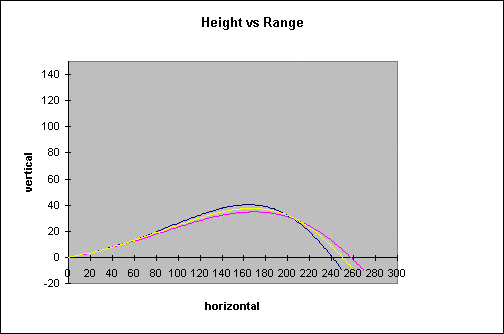
Club Angle of Attack -- ideally one's club path must be upwards at the point of contact with the ball (swinging up on the ball). Swing upwards increases launch angle and increases carry distance. Most amateurs club path is downwards when hitting the Driver. Learn more HERE. See this graphic. |
|
Optimum Loft -- the optimum loft for the Driver depends on club speed and angle of attack. Most amateur's use Drivers with too little loft. Thus, they are better off using a 3-wood off the tee. Learn more HERE. |

|
Sweet Spot -- point of contact with the ball must be the sweet spot to get maximum energy transfer. Missing the sweet spot means less distance and errant shots. |
Please complete this Golf Newsletter Feedback form so that I can provide you with more great golf tips you're looking for in 2010.
Golf Ball Trajectory Software
Are you looking for some software you can use to model the flight of the golf ball? In addition to my own, there are a few others out there ....
Currently, the version I sell deals with Driver shots only, unlike the version I use for my consultation business. This winter, I'll be working on a second version for sale.
This article summarizes some of the software programs out there.
1. The Tannar Golf Ball Trajectory Model
The spreadsheet will provide you with these additional features:
 |
Discover backspin rates resulting from different lofts and club speed. |
|
Explore optimum distances on soft fairways and firm fairways. Would you use different loft Drivers? |
|
Determine launch angles resulting from different lofts and club speeds. |
|
How does air temperature affect carry and total distance with different lofts? |
|
Coefficients of Restitution, COR, for all club speeds. |
|
Time of flight for all trajectories. |
|
Impact angles the the resulting roll along the fairway. |
|
Many of the measured values are plotted against one another on graphs. |
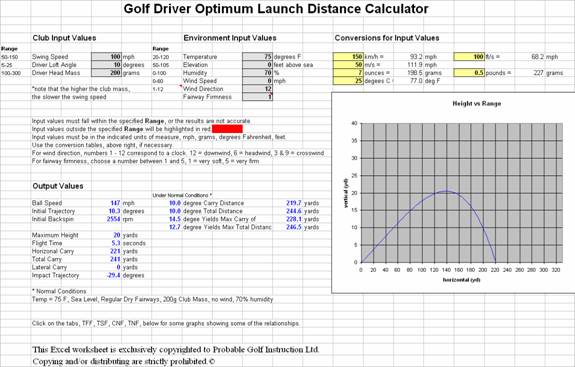
Order a copy of your own spreadsheet, that does all explained here, by using the following secure link:
Putting Statistics -- Track & Improve
Keeping
track of the number
of putts per round
is not the best
method of measuring
your putting ability.
The number of putts
you make depends
largely on the
length of the putts.
If you hit 14 greens
one day and then
5 greens the next,
it is highly likely
that you had fewer
putts when only
5 greens were hit
because the average
putting distance
was shorter. I
much better measure
is how many putts
you make from various
distances, whether
they be for birdies,
pars or bogeys
I
find that most
golfers are unrealistic
about they're putting
and so are very
hard on themselves
which leads to
more putts and
a negative effect
on the rest of
the game. For example,
a golfer hits the
first 8 greens
and
has
quite a
few chances for
birdie inside of
15 feet. He makes
none of them, grows
frustrated, puts
more pressure on
himself to hit
it even closer.
The result? His
ball striking deteriorates
and his score skyrockets.
Sound familiar?
How many 10 or 15 footers does one typically make? Take a look at this graph of Putting % versus Length of Putt (the graph will open in a new window). For a 10 footer (or about 3 metres), a touring pro averages 40%.
A high handicapper (15 - 30) averages 24%. A touring pro makes almost twice as many. Take a look at how much time those pros spend on their putting. These are averages. What we usually view on TV are the best players on the weekend. They have the lowest scores because they are sinking the most putts. They're having exceptional putting rounds. They are not putting their average.
When many golfers set their expectations for putting, however, they think of what they've seen on TV, yet few putt in anywhere near the time required to become that good of a putter. The golfer that hits the first 8 greens and doesn't sink a putt, their putting average to that point is 0% instead of the average 24%. On another day, their average may be 50% of the putts
One putt percentages don't give a true reflection of overall putting ability. Two players may sink 10% of their 15 footers, but one may 3 putt more of them. A better statistic is the average number of strokes taken from different distances. Here is a sample of stroke averages.
Putt Length |
Pro |
Hcp 0-4 |
Hcp 11 |
Hcp 26 |
Me |
3 feet |
1.07 |
1.22 |
1.35 |
1.50 |
1.15 |
6 feet |
1.32 |
1.46 |
1.62 |
1.86 |
1.42 |
10 feet |
1.54 |
1.63 |
1.83 |
2.10 |
1.62 |
15 feet |
1.75 |
1.76 |
1.98 |
2.29 |
1.72 |
20 feet |
1.86 |
1.86 |
2.10 |
2.43 |
1.92 |
30 feet |
1.96 |
2.00 |
2.27 |
2.61 |
2.02 |
40 feet |
2.00 |
2.10 |
2.38 |
2.77 |
2.07 |
50 feet |
2.10 |
2.20 |
2.50 |
2.91 |
2.39 |
I encourage you to keep your putting statistics like I do above so that you can monitor your progress. It will give you an accurate measure of how you're doing. You can compare your stats to the table above. All you need to do on your scorecard for each round is record the length of each putt and how many strokes it took to hole out. Pace out your distances trying to take 3 foot paces. As you gain experience, you'll be able to estimate many putts without pacing.
I've written a little spreadsheet program to keep track of your putting statistics. Make a purchase of anything I sell from my site and I'll send it to you as a BONUS. Just send me an email after your purchase to let me know you'd like it. OR, you can purchase it for only $5.99.
Trying to find answers on my website? Here's how.
1. Go to my Frequently Asked Questions (FAQ) page. There's a link to it on my pages from the left hand menu near the top of the page, just below the Search icon. It's called "FAQs." You then click on the graphic icon and you'll be taken to my database page. For your convenience, here it is:
FAQ
I've answered hundreds of questions over the past 6 years and have created a fairly large database. You can search it out. If you can't find the answer you're looking for, submit a question and I'll answer it.
2. On all of my web pages, there is a search feature in the top left section, right underneath my LOGO. Just place your search keywords in the search box, select "This Site" below it, and then press "Search." What will come up is a Google search of the pages on my site with relevance. You can also search the entire internet by selecting "Web" instead.
Go to my main page now: Home or just check the top left menu of this page.
3. Also, directly under the Google Search area, you'll find a pop down menu called "Your Topic." Select the topic of interest and press "Go."
I would suggest you bookmark my main page and/or your specific areas of interest so that you can find them easily in the future. On each page at the very top, there is a link you can click on:
"Click here to add this page to your favourites"
Hope you find all you're looking for.
You can learn more from NEW Titleist Pro-V1 by clicking HERE.
A list of resources that have been used to produce
this newsletter can be found on my web site here.
Hope I provided some useful ways for you to
become better prepared for you best golf season
ever.
Ken Tannar
If
you are interested in receiving a newsletter dedicated
to the ideas of this site, use the form below to
subscribe.
Privacy Statement: We will not
use your mailing address for bulk mailings (spam). We
will send information you have requested only.
Furthermore, the frequency we will deliver the
information will be small (about one email message per
month). We will not pass your email address to third
parties under any circumstances.
|