|
|
|
Having
Children
 What is
the likelihood of having 3 boys and 1 girl? Below is a list
of the possible outcomes. BBBB GBBB
GGBB GGGB
GGGG
BGBB
GBGB GGBG
BBGB
GBBG GBGG
BBBG
BGGB BGGG
BBGG
BGBG
There are
16 possible outcomes when having four children. Note
that there are 4 possible ways of having 3 boys and 1 girl (GBBB, BGBB, BBGB, BBBG). Thus the probability of having 3 boys and 1 girl is 4/16 or 0.25 (25%). If one were to take a random sample of 50 families with 4 children each, one would expect to find that 12.5 families (0.25 x 50), on average, would have 3 boys and 1 girl. The proba- bility of having 4 boys would be 1/16 or 0.0625 (6.25%) and in a sample of 50 families, one would expect to find that 3.1 families, on average, would have 4 boys. Golf
Shot Patterns
So, to
calculate, on average, the expected number of times out
of 50 shots you would hit the ball 10 yards left and 10 yards short of your target, you would use E = P x 50, where P is the probability of hitting the ball to that position. You would calcu- late P by dividing the number of times you hit to that position by the total number of shots. The greater the number of shots, the more accurate your estimate of probability. By documenting
how many times you hit the ball to all the
possible positions relative to your target, you can calculate the respective probabilities. Below is a summary of my shot pattern with medium irons 5 thru 7. 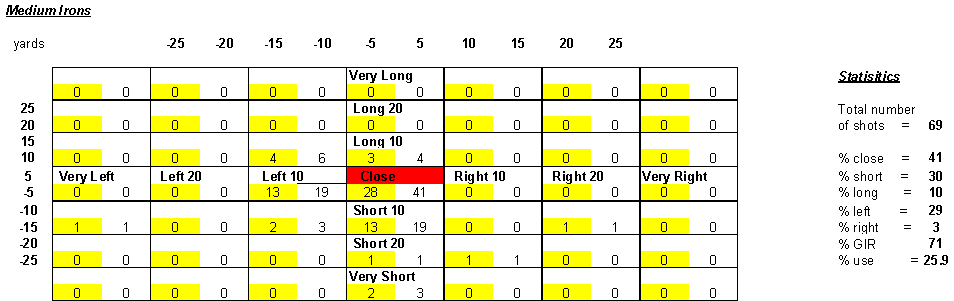 Each of
the yellow cells contains the number of times I hit to
that position, relative to my target. Out of 69 shots, I hit within 5 yards of my target 13 times. If I were to continue that shot pattern, the probability of hitting within 5 yards of my target in the future would be 13/69 or about 18.8%. Likewise, I hit 10 yards short and 10 yards left 2 out of 69 shots, or 2.9% of the time.
To calculate the expected score on a hole, one
needs to
combine the shot pattern above with the target and its sur- roundings. For instance, if I were to aim at the pin when it is cut 10 yards short and 10 yards left of the center of the green described earlier, then:  I
would have an 18.8% chance of hitting with 5 yards of I
would have an 18.8% chance of hitting with 5 yards of the pin. From there, I would likely take 1.6 putts to hole out based on my putting statistics (shown below). Thus there is an 18.8% chance of scoring 2.6 on the hole. I
would have a 2.9% chance of hitting 10 yards short and 10 yards left. With this pin placement, the shot would land in the water hazard. I would drop in front of the hazard, play about a 60 yard pitch, hopefully hit the green, and then putt out. My expected score would depend on my pitching ability (past statistics indicating how close I would likely pitch the ball) and then on my putting ability (see below). My expected number of shots from 50 yards is 2.77. Thus I would have a 2.9% chance of scoring a 4.77 on the hole, likely a double- bogey. 
If one
adds the probabilities of each region in my shot pattern
together, they will add to 100%. This means that there is a 100% chance of hitting the next shot somewhere within the shot pattern (excluding a few of those really ugly shots which don't truly represent my ability). To calculate the expected score on a given shot, one must add the expected outcomes from each region. E = P x
score + P x score + P x score +
. . . . . . + P x score
= 0.188 x 2.6 + 0.029 x 4.77 + . . . .
. .
= with 5 yds + 10 yd left, 10 yd short +
. . . . . .
= 4.32
Adding
together each expected score from each region
multiplied by the probability of hitting each region yields 4.32 strokes. Thus, if I were to aim at the pin when it is 10 yards left and 10 yards short of the middle of the green, I would most likely score 4.32, on average. Sometimes I would make 2, sometimes 3, sometimes 4 or 5 or even 6. The average would be 4.32. I would likely lose the hole if in a match.
Mathematics
of Predicting Outcomes of Shots
Rolling
Dice
Consider
rolling a pair of dice. What is the probability of
rolling a 7? One can answer this question by analyzing the total possible number of different outcomes of rolling the dice. With a pair of dice, one can roll the numbers 2 thru 12. There is only one way to roll a 2 (1 & 1), two ways of rolling a 3 (1 & 2 or 2 & 1), 3 ways of rolling a 4 (1 & 3, 3 & 1, 2 & 2), etc. The number of ways to roll each outcome is summarized in the table below. The 1st row lists the possible outcomes, the 2nd row lists the number of each possible outcome, and the 3rd row lists the probability of each possible outcome.
Note that
there are 6 possible ways of rolling a 7 (4 & 3, 3 & 4, The
laws of probability state that to determine how many
times an expected outcome, E, (due to chance) will occur, one needs to know the probability, P, of the outcome and the number of trials, N, to achieve the outcome. The equation is: E
= P x N
Perform the
following experiment. Roll a pair of dice 50 times
and count the number of times you roll a 7 and a 2. If you were to repeat this experiment many times, you would likely roll a 7 a total of 9.7 times ( 0.194 x 50) and a 2 a total of 1.4 times (0.0278 x 50). Of course the 9.7 and 1.4 are averages of what you would observe. In one experiment you might roll a 7 a total of 12 times and in the next experiment it might be 8 times. ©Probable Golf Instruction, Ken Tannar 2001-2015. All Rights Reserved. Langley, B.C. V2Y 2G4 CanadaPhone: 604-309-7030 FAX: to fax, email an attachment probablegolf@yahoo.ca or golfexpert@probablegolfinstruction.com |
| GOLF ASSISTANTS |
|
Golf Trip Pairing CalculatorPlanning a golf trip with some friends/family? Trying to sort out the foursomes so people don't play too often with others? Order your ready made Spreadsheet. Type in the names, print out the groupings. Minimize repeat pairings.
Wind Caddy will advise you on aim, distance and club so that you can play the wind successfully. It takes the guess work out of club selection. New option to enter custom distances for each club. The algorithm will make a club suggestion accordingly. Use the right club in every condition!
|

|
|


| GOLF NEWS |
Golf Putting Green Reading Glasses |
| GOLF NEWSLETTER |
Statistics
·Putting
·Longest Golf Balls
·Games
·Handicap
·Scoring
·Shot Patterns
·Tournaments
·PGA Tour Stats
Pro Shop
·Ball Marker Engraved
·Books
·CDs & DVDs
·Green Reader
·Impact Labels
·Laser Rangefinder
·Longer Drives
·Products
·Teaching Aids
|
|
| GOLF POLL |
The 19th Hole
·Advertising
·Ask the Golf Expert
·Consultation/Litigation
·FAQs
·Golf Blog
·Golf Draws
·Links
·Science of Golf
·Tell a Friend
·Testimonials
·

Golf Ball Finder Glasses
Find all your errant golf balls and many more!
| GOLF TIPS |
How to play:
|